

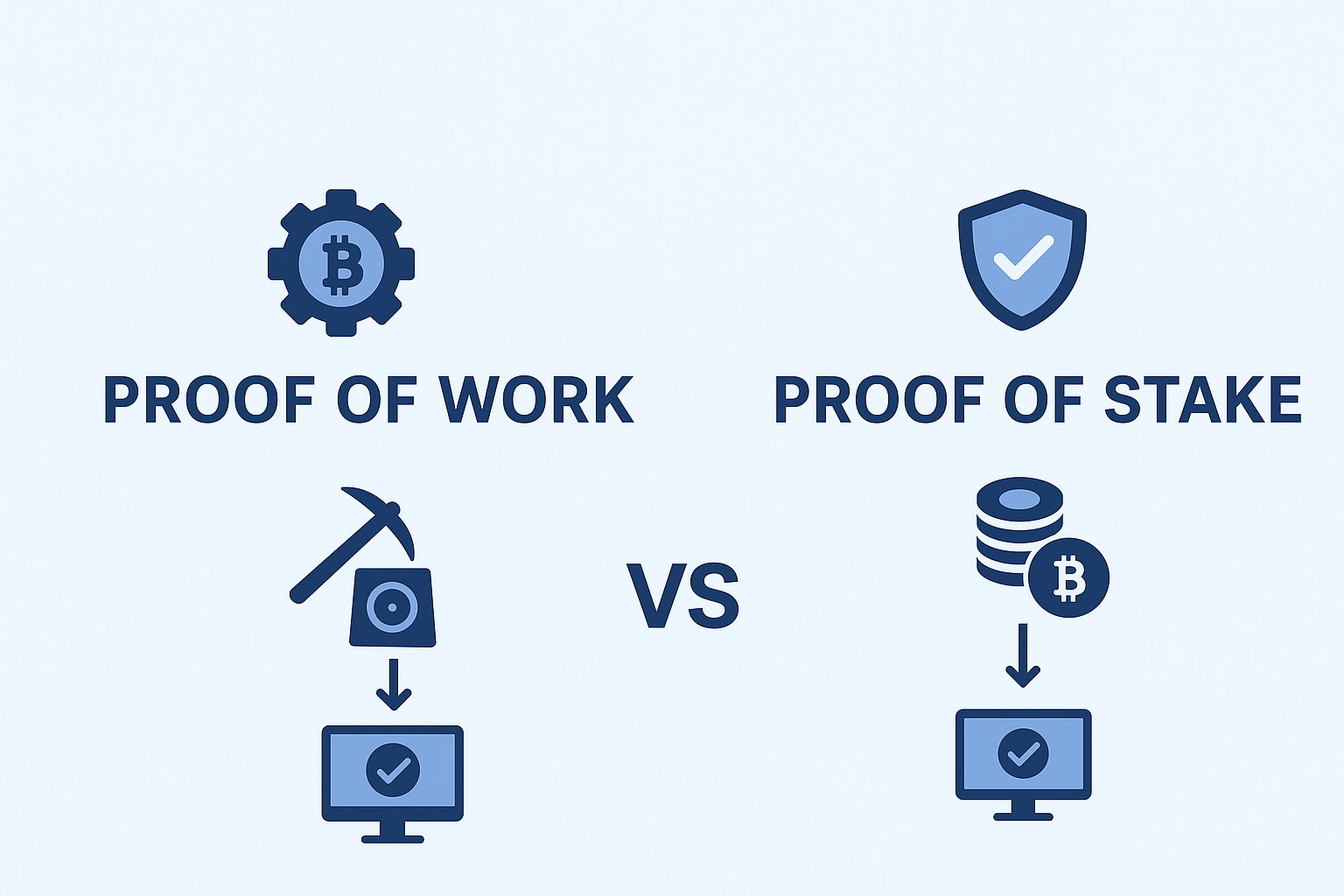
Cryptocurrencies rely on consensus mechanisms to validate transactions and secure the blockchain. Two of the most prominent mechanisms are Proof of Work (PoW) and Proof of Stake (PoS). While PoW was pioneered by Bitcoin and became the original blockchain consensus model, PoS has emerged as a more energy-efficient alternative, adopted by networks like Ethereum, Cardano, and Solana.
What is Proof of Work (PoW)?
Proof of Work is the earliest consensus mechanism, first used in Bitcoin (2009).
- In PoW, miners compete to solve complex mathematical puzzles using powerful computers.
- The winner gets the right to validate the block and is rewarded with newly minted coins and transaction fees.
- This process is called mining.
Key Features of PoW:
- Security through computational power – Attackers would need massive computing resources to manipulate the blockchain.
- Decentralization – Anyone with hardware and electricity can participate.
- High energy consumption – Mining requires enormous electricity, raising environmental concerns.
Examples of PoW Coins: Bitcoin (BTC), Litecoin (LTC), Dogecoin (DOGE).
What is Proof of Stake (PoS)?
Proof of Stake was introduced as an alternative to PoW to reduce energy consumption.
- In PoS, validators are chosen to create new blocks based on the number of coins they “stake” (lock up as collateral).
- Instead of competing with computing power, participants are selected randomly, with higher stakers having higher chances.
- Validators earn rewards for honest participation but risk losing their stake (slashing) if they act maliciously.
Key Features of PoS:
- Energy efficiency – No need for massive hardware or electricity.
- Scalability – PoS systems can handle more transactions per second.
- Security via economic penalties – Malicious actors lose their staked coins.
Examples of PoS Coins: Ethereum (ETH), Cardano (ADA), Solana (SOL), Polkadot (DOT).
Head-to-Head Comparison
| Aspect | Proof of Work (PoW) | Proof of Stake (PoS) |
| Energy Use | Very high (requires mining rigs & electricity). | Very low (validators only run standard computers). |
| Security Model | Based on computational difficulty (51% attack costly). | Based on economic stake (attackers risk losing funds). |
| Accessibility | Requires expensive hardware & cheap electricity. | Anyone holding coins can participate as validator. |
| Transaction Speed | Slower, limited scalability. | Faster, better scalability (more transactions/sec). |
| Decentralization | Tends to centralize around big mining farms. | Risks centralization with large stakeholders. |
| Environmental Impact | High carbon footprint. | Eco-friendly alternative. |
| Maturity | Battle-tested (Bitcoin has never been hacked). | Newer, still evolving but widely adopted. |
Which is Better?
There is no absolute “better” mechanism, it depends on the blockchain’s goals:
- PoW is ideal for maximum security and decentralization (Bitcoin remains the gold standard).
- PoS is better for scalability, energy efficiency, and modern use cases like smart contracts and decentralized finance.
In practice, the crypto industry is moving towards PoS for sustainability, with Ethereum’s transition being the biggest shift. However, PoW is likely to remain dominant in Bitcoin and a few other projects where energy-backed security is valued.
Conclusion
Proof of Work and Proof of Stake represent two different philosophies in blockchain design: one prioritizes brute-force security, while the other emphasizes efficiency and sustainability. Both play crucial roles in the evolving crypto ecosystem, and understanding their differences is essential for investors, developers, and enthusiasts alike.