

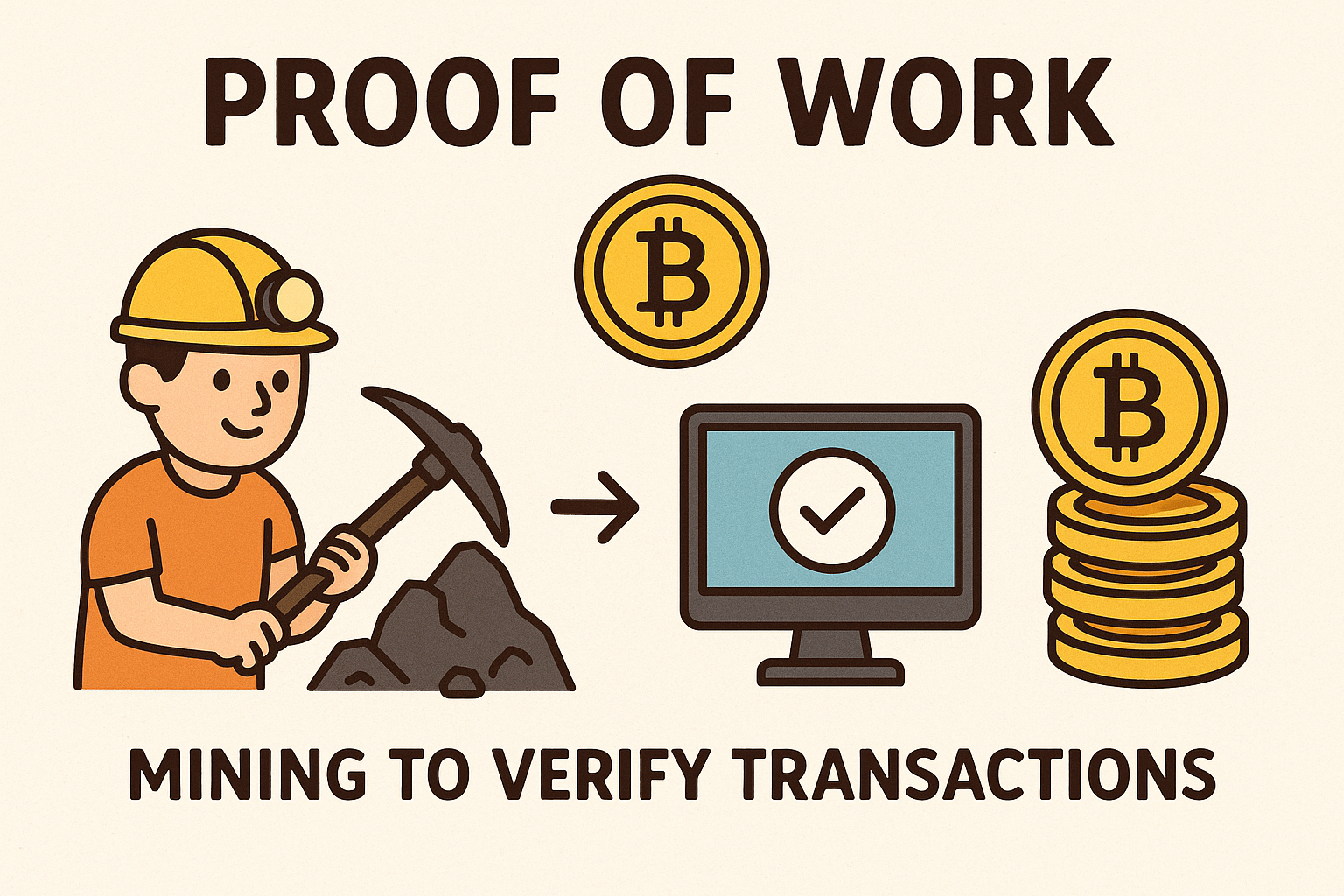
When people hear about Bitcoin or other cryptocurrencies, one term often comes up: Proof of Work (PoW). It sounds technical, but at its core, it’s just a way for computers to agree on who gets to update the blockchain — the public record of all transactions. PoW makes sure no one cheats, while rewarding those who keep the system running.
What is Proof of Work?
Proof of Work is like a digital contest where powerful computers compete to solve very hard math puzzles.
- The winner gets the right to add a new block of transactions to the blockchain.
- The winner also earns a reward in cryptocurrency (like Bitcoin).
It’s called “proof of work” because the computer must show it actually did the work (solving the puzzle) before being allowed to add new information.
How Does PoW Work?
Here’s the step-by-step process:
- Transactions waiting
People send crypto (e.g., Alice sends 1 BTC to Bob). These transactions go into a waiting room called the mempool. - Miners get to work
Miners (specialized computers) gather these pending transactions into a block. - Solving the puzzle
Miners must solve a math puzzle by making countless guesses. The puzzle is so tough that it may take billions or trillions of tries. - First to solve wins
The first miner who finds the correct answer shares it with the network. Other miners check the solution quickly. - Block added to blockchain
Once verified, the block is added to the chain of previous blocks, forming the blockchain. The winning miner earns:- New coins, block reward, is currently 6.25 BTC per block (as of 2025).
- Transaction fees from people who sent coins in that block.
Real-World Analogy
Imagine a classroom:
- The teacher gives a very hard riddle.
- All students start guessing answers as fast as they can.
- The first student who solves it correctly gets to write on the board (like adding a block to the blockchain).
- As a reward, they also get a chocolate (like earning Bitcoin).
This makes sure only hard workers can win, and nobody can just cheat by shouting an answer.
Bitcoin Example
- Bitcoin uses Proof of Work to secure its network.
- A new block is mined roughly every 10 minutes.
- The mining reward started at 50 BTC in 2009, but it halves every four years (this is called the halving).
- Today, miners earn 6.25 BTC per block + fees, and the next halving (in 2028) will cut this to 3.125 BTC.
Why is Proof of Work Important?
- Security – It’s very hard and expensive to attack the Bitcoin network because you’d need massive amounts of computing power.
- Decentralization – No single authority decides who wins; it’s a fair competition.
- Trustless system – You don’t need to trust banks or middlemen. The math ensures fairness.
Advantages & Disadvantages
Pros:
- Extremely secure and battle-tested (used in Bitcoin since 2009).
- Fair: anyone can participate if they have the hardware.
- Prevents double-spending and fraud.
Cons:
- Uses huge amounts of electricity (comparable to small countries).
- Requires expensive machines (ASIC miners).
- Mining tends to centralize in regions with cheap electricity.
- Slower and less energy-efficient compared to alternatives like Proof of Stake.
Conclusion
Proof of Work is the foundation of Bitcoin and many early cryptocurrencies. It ensures fairness, security, and decentralization, but at the cost of high energy use and expensive hardware. While newer systems like Proof of Stake are gaining popularity, PoW remains one of the most trusted and secure ways to run a blockchain.
In simple terms: Proof of Work is like a global puzzle-solving race. The winner adds the next page in the blockchain’s history book and gets rewarded with crypto.